Devlog: Environment Design
During our end of January sprint, I decided to tackle designing the environment the game would be played in, a wizard tower that would be filled with magical trinkets and which would have different areas dedicated to playing the minigames, forming the main game loop where players receive their tasks for the day, then run around to different minigame stations and complete their task list, all the while being asked to resist the temptation of being distracted by the magic Orb in their hand.
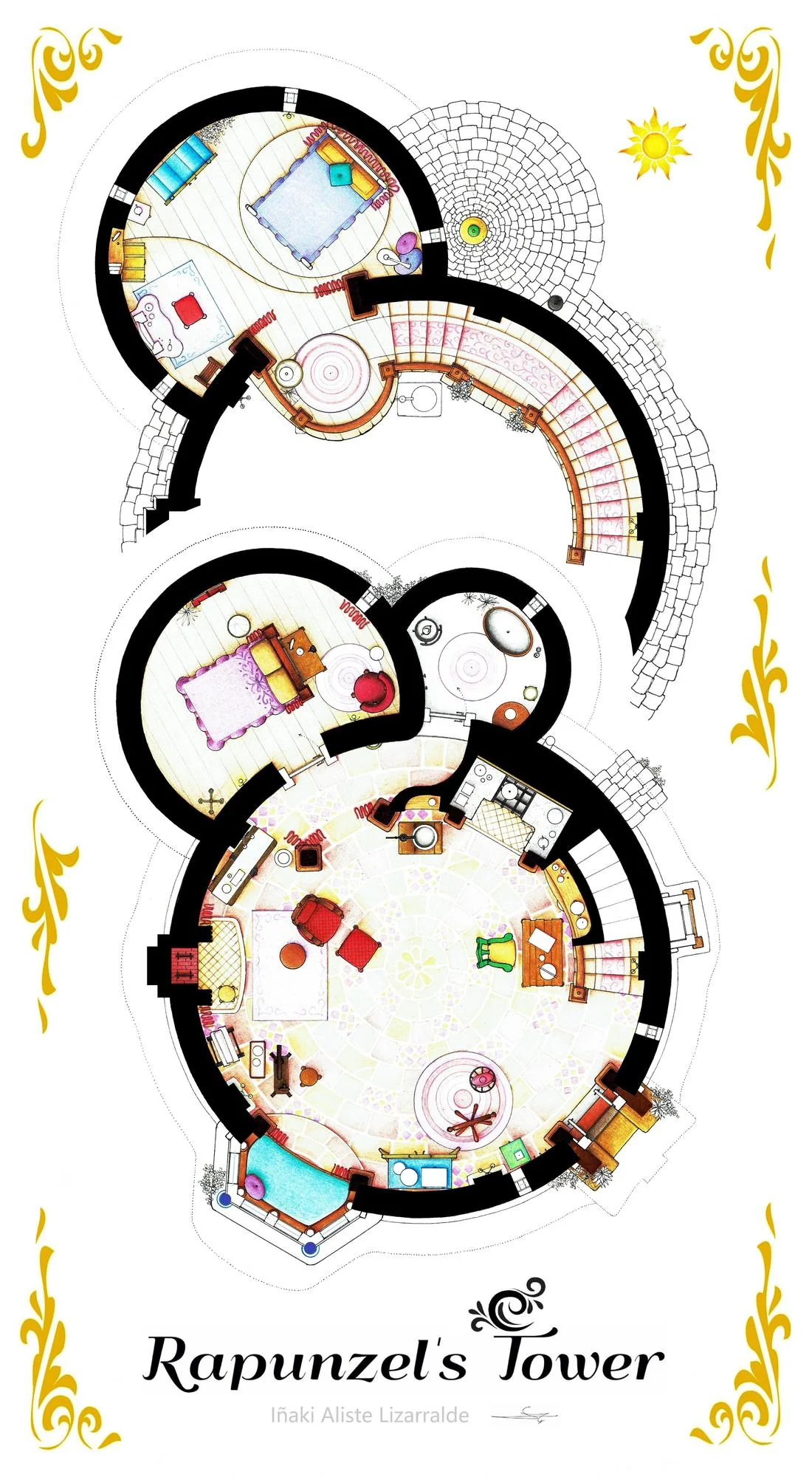
My original plan was to make a circular floor with various walls cutting through it to make different rooms, but after coming across this fan-made floorplan of Rapunzel’s tower from the Disney movie Tangled (p. 1), I found myself drawn to the idea of a tower with multiple separate wings, each with their own decorations. With this in mind, I sketched a number of possible floor plans to show the rest of the team (p. 2). The most successful designs among team members were the two circular rooms in the top right of the image, and the bird-shaped design to the left of those circles. The circles, despite being a backtrack in terms of room design, were popular choices because of the inclusion of a second floor. Team members, myself included, were excited about the possibilities afforded by adding a second floor. My initial instinct for this extra room is to add another minigame and more minigame stations up there and have the second floor be locked at the start of the game and unlock as the player progresses, adding another dimension of difficulty, both in terms of having to learn a new minigame mechanic and having to add more information to their mental map of the tower. However, the team agreed that the circular rooms were too boring to be our final design and that we wanted a more dynamic shape.
The bird-shaped design in particular was well received because depending on where the player stands in the space, they can have a drastically different scope of vision of the minigame stations in the room: standing in the center, the player is essentially a panopticon, able to see everything in the room. However, the moment they move into any of the distinct wings of the tower, they lose visual access to at least one other wing.
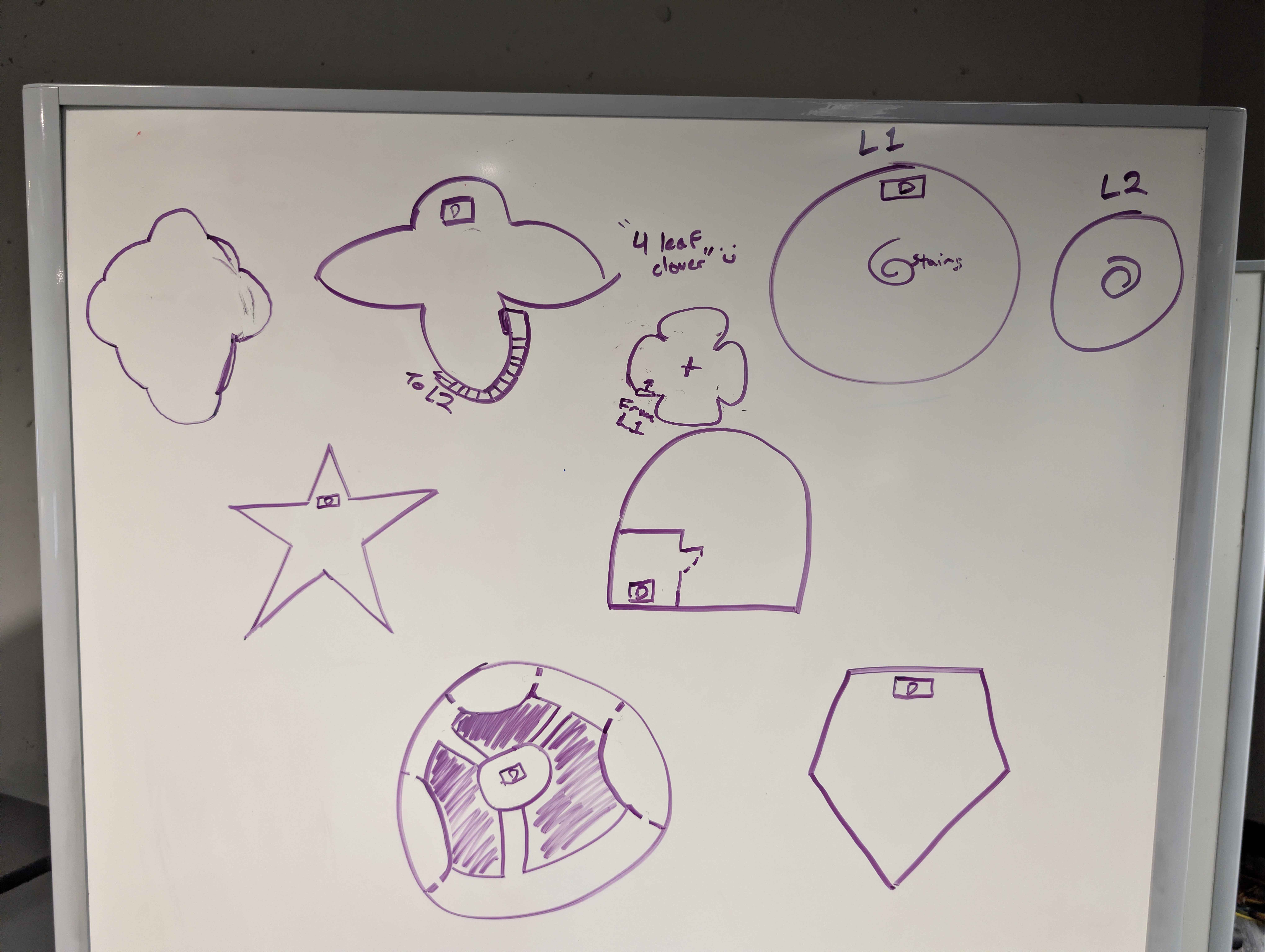
Because both the multi-leveled nature of the former design and the more dynamic shape of the latter design were both very popular with team members, I decided to combine the two by adding a staircase that would wrap around one of the wings of the tower and lead up to a second floor. My idea for hiding the stairway during the early parts of the game is to place the entrance behind a bookshelf which will be moved out of the way in a cutscene during the rising action of the game.
Because our game has 3 distinct minigames and the tasks asked of the player each day are randomized, I didn’t want to simply fill each wing of the tower with a single type of minigame. Instead, I intend to design a space where each type of minigame has multiple possible stations it can “spawn” at, and those stations are scattered across each wing. The second floor would also contain minigame stations for the first 3 minigames, and unlocking the fourth minigame on the second floor would recontextualize items on the first floor as new minigame stations.
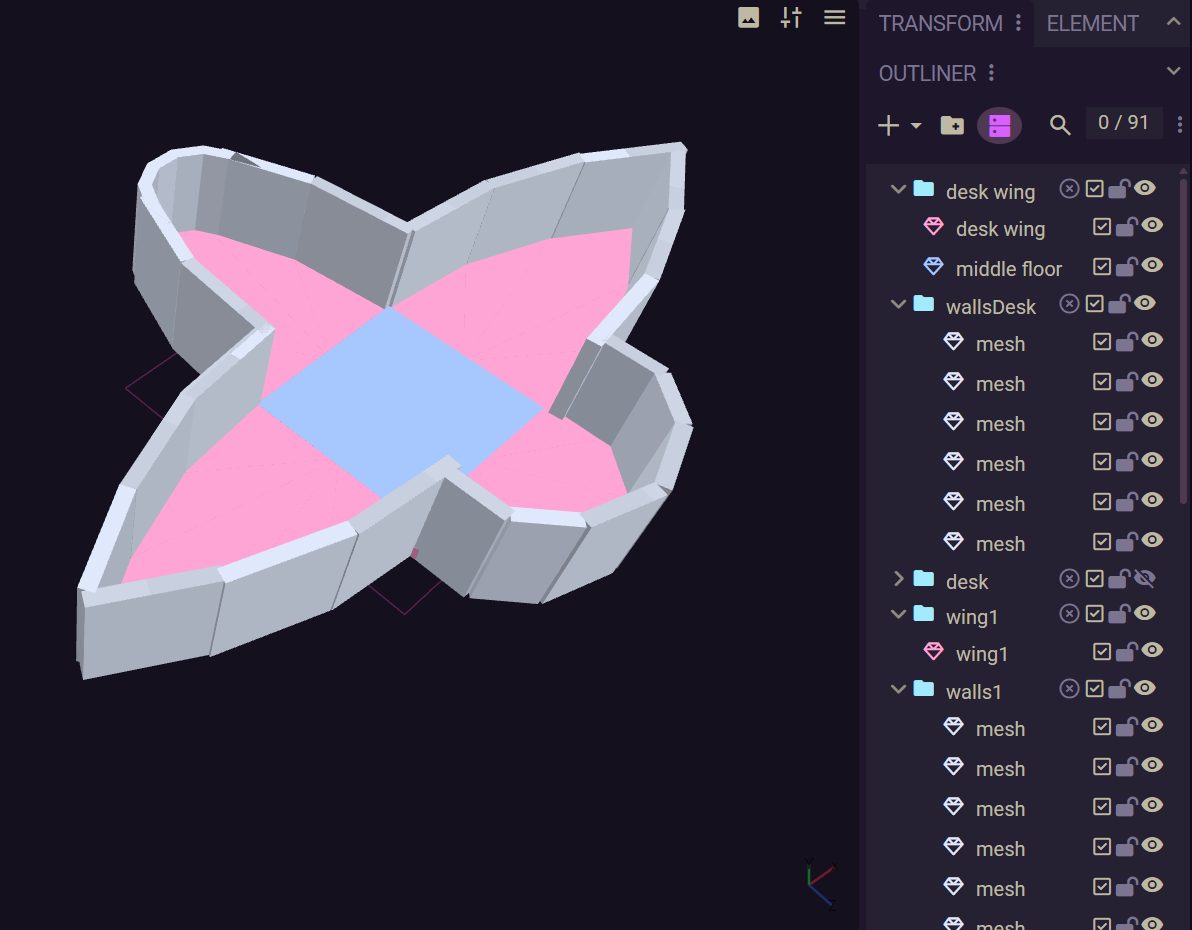
Since DoomScroll’s graphical style is going to be a low-poly pixel art aesthetic, I thought it would be fitting and valuable to create all the game’s 3D models in Blockbench to familiarize myself with the program. In a couple of hours of work, I had created a rough first floor very similar to the original bird-shaped sketch (p. 3), albeit with a more rounded “beak” to accommodate a staircase wrapping around the outer edge of that section. My immediate concern for next week’s sprint is to create the second floor, the staircase leading up to it, and the secret doorway that grants access in the first place.
Leave a comment
Log in with itch.io to leave a comment.